AI Strategy & Transformation · Prepared by FutureInSites · March 2026

Building the AI Foundation for Lululemon's Next Growth Chapter

AI Strategy & Transformation · Prepared by FutureInSites · March 2026
Building the AI Foundation for Lululemon's Next Growth Chapter
"We see an exciting opportunity to further leverage AI and technology to advance our product innovation process, improve our agility and speed to market, and bring more engagement and personalization to our guest experience."Calvin McDonald · CEO, lululemon athletica · August 2025
Executive Summary
Three Strategic Priorities
Activate Lululemon's 20M+ loyalty members as a true competitive moat through unified behavioral data.
Embed AI into the design-to-market lifecycle to close the gap with AI-native fast-fashion competitors.
Scale personalization from a DTC channel tactic to a company-wide capability that deepens brand loyalty.
The Inflection Point
Lululemon grew at 42% in FY2022 and 30% in FY2023. By FY2026, growth has slowed to under 5%, and analyst consensus projects continued single-digit growth through 2031. Management has acknowledged the core cause: product life cycles ran too long, the line became too predictable, and the brand missed opportunities to create new trends.
Three structural forces are reshaping the competitive environment in ways that pure brand investment cannot solve:
AI-native fast-fashion competitors (Zara, Shein) are collapsing design cycles from months to weeks. Real-time inventory AI is eliminating the markdowns that erode margin. And hyper-personalized digital experiences are raising customer expectations, making generic experiences feel inadequate.
Lululemon's $500M Mirror write-off is critical context: bold technology bets can go catastrophically wrong. The new AI strategy must balance ambition with governance discipline.
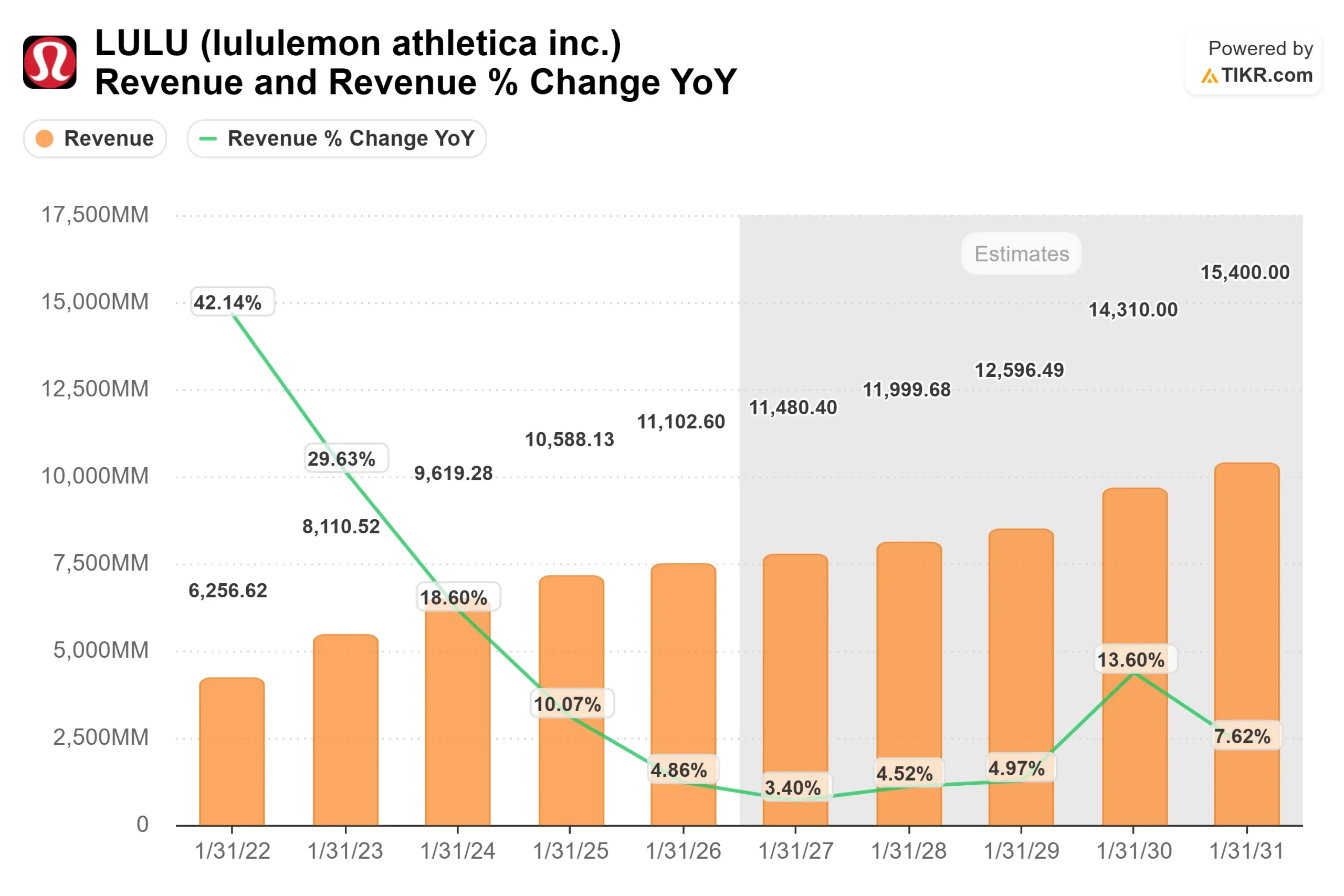
Fig. 1: Lululemon Revenue & YoY Growth Rate, FY2022–FY2031E. Revenue growth has decelerated from 42% to under 5%, with analyst consensus projecting continued single-digit growth. Source: TIKR
AI Readiness Assessment
Not all "AI" creates equal strategic value. A capability tier framework distinguishes between proprietary IP, licensed platforms, and commodity tools: the distinction that determines competitive moat and investment priority.
Built, trained, or engineered internally. Genuine competitive moat; cannot be purchased by competitors.
Vendor platforms configured and integrated by Lululemon. Replicable, but requires operational expertise.
Tools where Lululemon is simply a customer. Value from early adoption, not proprietary capability.
Competitive Intelligence
Lululemon faces a two-front competitive threat: legacy athletic brands with significant AI head starts, and agile culture-first challengers targeting its core customer.
| Brand | AI Maturity | Key AI Bets & Observations |
|---|---|---|
| Nike | High | Acquired Celect (demand forecasting: 6 months → 30 minutes); Nike Adapt Link AI-designed sneaker (2025); unified CDP at 100M+ members; athlete biometric integration |
| Lululemon | Medium / Ascending | New CAITO role (Sept 2025); PAVE ML platform; DTC personalization scaling; supply chain AI active; product design AI in PoC stage |
| Adidas | Medium | Findmine AI partnership for outfit recommendations; AI-personalized shopping; following rather than leading in AI innovation |
| Alo Yoga | Medium | AI-enabled influencer marketing; culturally resonant positioning; aggressively targeting Lululemon's core customer with values alignment |
| Under Armour | Low / Catching Up | Appointed Head of AI & Advanced Analytics in 2025; using IBM AI technology; clearly in reactive mode |
| Vuori | Emerging | Fast-growing challenger; limited public AI strategy; competing on brand story and lifestyle positioning |
U.S. Athleisure Market Share

Fig. 2: U.S. Athleisure Market Share. Lululemon holds 21.2% of the U.S. market vs. Nike's 31.6%, with significant white space in the remaining 47.2%. Source: Euromonitor International, 2024.
Proven AI ROI: Already Achieved
Fig. 3: Proven AI ROI metrics already achieved by Lululemon. Results span digital advertising, e-commerce conversion, and supply chain efficiency. Sources: Lululemon investor presentations; company disclosures, 2023–2024.
AI Strategy Framework
Lululemon's AI strategy is organized around three pillars that reflect its core business priorities and evidence-based capability gaps. Each pillar generates returns independently; the full compounding effect emerges when all three operate together.
Protect Margin
Use AI to improve efficiency, reduce cost, and protect margin across back-office and store operations. Fastest measurable ROI; primarily BUY or PARTNER decisions using proven vendor tools on Lululemon's proprietary operational data.
Win on Product
Embed AI in the design-to-market lifecycle to close the gap with AI-native fast-fashion competitors. Highest strategic urgency; Zara already compresses design cycles to weeks using these capabilities.
Deepen Loyalty
Activate 20M+ loyalty members as a unified intelligence asset. Extend PAVE from a marketing-scoring tool to a full customer lifetime value engine across every touchpoint; the only BUILD quadrant initiative.
AI Use Case Prioritization
Twelve AI initiatives plotted across a value/complexity matrix. Quick Wins (high value, lower complexity) should be funded immediately. Strategic Investments require phased commitment and governance rigor.

Fig. 4: Lululemon AI Use Case Prioritization Matrix. Numbered circles (1–12) map directly to the initiative cards below. Source: Original analysis.
Quick Win Initiatives: Fund Immediately
Already live. +8% ROAS, 6%→15% new customer revenue. Expand internationally.
+35% AOV, +25% conversion proven. Extend from DTC to full omnichannel.
Highest urgency gap. Zara already weaponized this. Fund and deploy immediately.
PAVE foundation exists. Activate 20M+ loyalty members as competitive moat now.
Strategic Investments: Phased Commitment
$18M foundation invested. Multi-year build to full real-time optimization platform.
Post-Nike suit urgency. Requires AI system integration with legal and IP workflows.
Requires geo-data platform and discovery tooling. Strong community brand impact when built.
Proof-of-concept exists. Requires AI training platform build for franchise brand scale.
Reconsider / Low Priority: Monitor & Defer
+25% conversion potential but high vendor dependency and integration complexity.
High complexity relative to near-term value. Phase with new international store openings.
Multi-year complexity. Tariff uncertainty adds execution risk. Monitor for right timing.
Builds on PAVE but requires CIP unification first. Defer until Pillar 3 foundation is set.
Strategic Recommendations
Each recommendation is grounded in evidence from the current business, tied to a specific AI capability, and sequenced by urgency and feasibility.
CEO Calvin McDonald identified product lifecycle staleness as the primary driver of the Americas decline: "letting product life cycles run too long." Build an AI-powered Trend Intelligence System drawing from internal sales signals, social listening, and competitor launches. Management's target of 35% new style penetration in North America requires exactly this capability; trend intelligence must precede product development, not follow it.
Lululemon has 20M+ loyalty members and PAVE already scoring profiles. Evolve from using loyalty data for marketing efficiency to using it as a full customer lifetime value engine, deepening retention, increasing purchase frequency, and expanding wallet share per member. Extend PAVE scoring into in-store associate recommendations, membership tier optimization, and churn prediction. Loyalty economics are a margin lever, not just a growth lever.
Lululemon faces simultaneous margin headwinds: ~$240M tariff impact, 290bps gross margin decline, and the cost of international scaling. Three operational priorities in sequence: inventory optimization to restore full-price sell-through; higher DTC channel penetration via AI-powered personalization; and vendor/supply chain consolidation through AI-assisted supplier analytics.
Lululemon's clearest growth engine is international (China at 46% growth, six new markets in 2026, and a franchise model shift). AI must be embedded in the expansion infrastructure from day one, not retrofitted later: localized personalization, AI-trained franchise associates for brand consistency, trend intelligence calibrated to WeChat and Xiaohongshu/RED, and store layout optimization for every new opening.
The $500M Mirror write-off is the most important context. Three governance mechanisms must be established in parallel with the first wave of AI investments: AI Investment Stage Gates with pre-defined kill criteria; a Responsible AI Framework within 90 days (GDPR, CCPA, algorithmic bias); and an AI Center of Excellence: a cross-functional team setting standards, reviewing model deployments, and managing the build/buy/partner portfolio systematically.
Recommended Priorities by Horizon
| Horizon | Recommendation | Primary Business Impact |
|---|---|---|
| 0–12 mo | Rec. 5: AI Governance Framework | Risk mitigation; enables all other investments |
| 0–18 mo | Rec. 2: Personalization & Loyalty Monetization | Higher LTV, reduced churn, lower CAC |
| 0–18 mo | Rec. 3: Operational Efficiency AI | Margin preservation; full-price sell-through |
| 6–24 mo | Rec. 1: Product Innovation as AI-Defended Moat | Revenue recovery; competitive differentiation |
| 12–36 mo | Rec. 4: International AI Infrastructure | International growth quality; brand consistency |
Financial Business Case
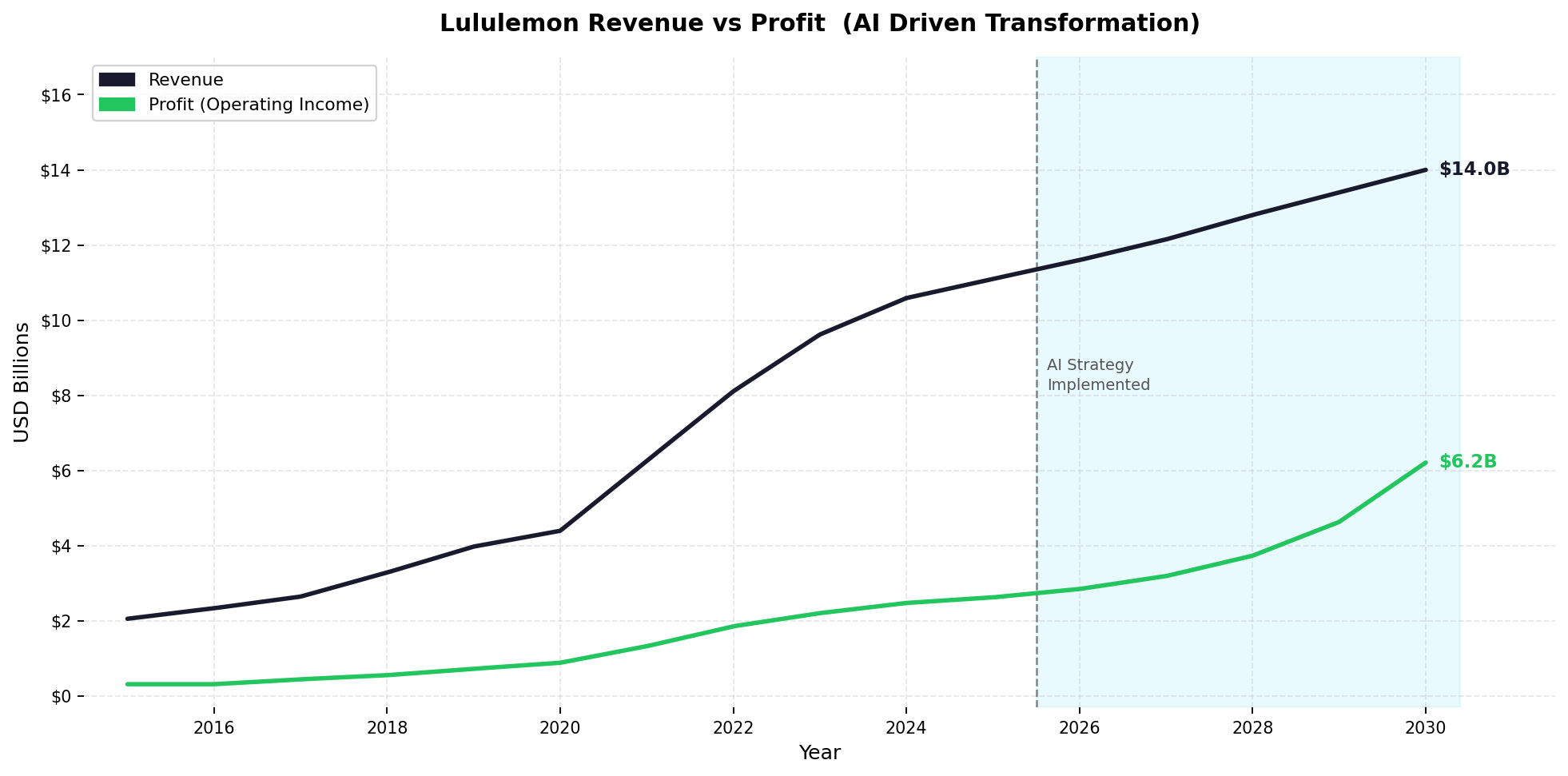
Fig. 5: Lululemon revenue vs. operating profit, 2015–2030E. Margin expansion potential from AI-driven efficiency compounds across all three strategic pillars. Source: Original analysis.
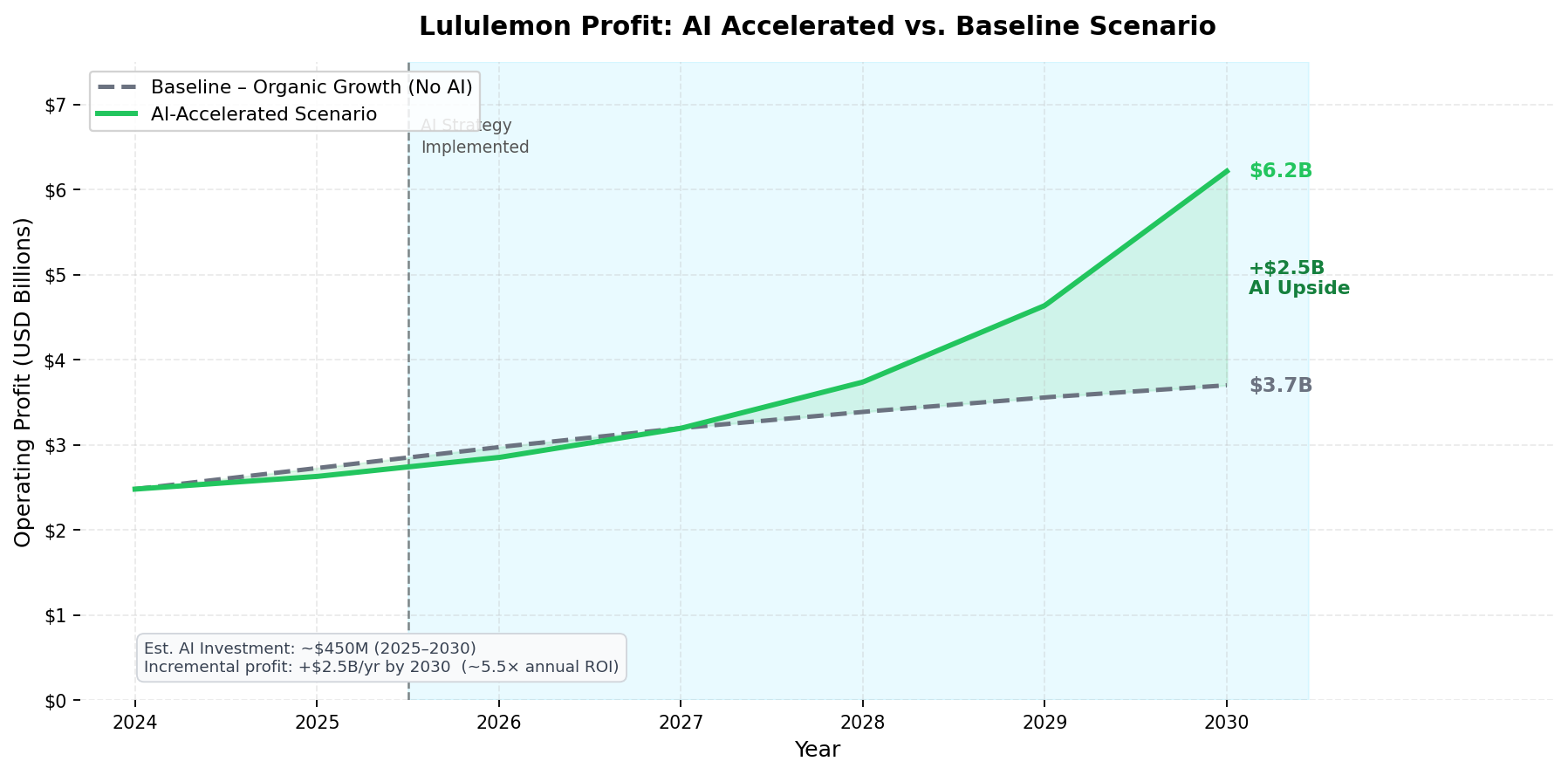
Fig. 6: Projected operating profit under two scenarios. Baseline (no AI): organic growth to ~$3.7B by 2030. AI-accelerated: ~$6.2B by 2030. The steeper profit curve versus revenue reflects structural cost reduction — AI reduces labor requirements, supply chain waste, and markdown exposure, dramatically expanding margins even as revenue grows at a modest pace. ~$450M AI investment projected at ~5.5× annual ROI (~9× cumulative over 2025–2030). Source: Original analysis.
Read the Full Strategic Analysis
View the Full Report →